Bash script for starting and stopping Oracle Application (EBS) R12 12.2

I am working on a new script/set of scripts for single-instance database cloning and came across the need to shut down and restart the application by calling a second script. Here, I am sharing it with you today. Copy it to a fresh .sh file, name it whatever you want, and enjoy! :) Do not forget to adjust the passwords!

#!/bin/sh

: <<'END'
This script is ran as "root"
This script is meant for single instances.
This script expects both ORACLE, APPLMGR users bash profiles sourcing environment files.
This script was last tested against Oracle EBS R12 12.2.10/19c
Last modified on: 2nd October 2024
Author: Rajesh Thampi
License: Public
END
me=$(basename "$0")
ORACLE_SID=$(su - oracle -c 'echo "$ORACLE_SID"')
APPS_ORACLE_CONTEXT=$(su - applmgr -c 'echo "$CONTEXT_NAME"')
APPS_SCRIPTS_HOME=$(su - applmgr -c 'echo "$RUN_BASE/inst/apps/$CONTEXT_NAME/admin/scripts"')
DB_SCRIPTS_HOME=$(su - oracle -c 'echo "$ORACLE_HOME"')/appsutil/scripts/$APPS_ORACLE_CONTEXT

if [[ -z $1 ]]; then
    echo "No parameter was passed"
    exit 1
else
    if [[ "$1" == "start" ]]; then
        echo "All Oracle EBS R12 Services will be started now."
        su - oracle -c "sh $DB_SCRIPTS_HOME/adcdbctl.sh start;"
        if [ $? -ne 0 ]; then
            echo "Couldn't start the database services successfully. Aborting"
            exit 1
        else
            su - oracle -c "sh $DB_SCRIPTS_HOME/adcdblnctl.sh start $ORACLE_SID;"
        fi
        if [ $? -ne 0 ]; then
            echo "Couldn't start the listener services successfully. Aborting"
            exit 1
        else
            su - applmgr -c "cd $APPS_SCRIPTS_HOME;{ echo apps; echo apps; echo password123; } | adstrtal.sh;"
        fi
        if [ $? -ne 0 ]; then
            echo "Couldn't start the Application services successfully. Check log files for errors and try again"
        else
            echo "All EBS Services were successfully started."
        fi

    elif [[ "$1" == "stop" ]]; then
        echo "All Oracle EBS R12 Services will be stopped now."
        su - applmgr -c "cd $APPS_SCRIPTS_HOME;{ echo apps; echo apps; echo password123; } | adstpall.sh;"
        if [ $? -ne 0 ]; then
            echo "Couldn't stop the application services successfully. Aborting"
            exit 1
        else
            su - oracle -c "sh $DB_SCRIPTS_HOME/adcdblnctl.sh stop $ORACLE_SID;"
        fi
        if [ $? -ne 0 ]; then
            echo "Couldn't stop the Listener services successfully. Aborting"
            exit 1
        else
            su - oracle -c "sh $DB_SCRIPTS_HOME/adcdbctl.sh stop immediate;"
        fi
        if [ $? -ne 0 ]; then
            echo "Couldn't stop the Database services successfully. Check log files for errors and try again."
            exit 1
        else
            echo "All EBS Services were successfully stopped."
        fi
    else
        echo "Syntax: sh $me start/stop"

    fi
fi

That’s all folks. Have comments? let me know

javax.net.ssl.SSLHandshakeException: sun.security.validator.ValidatorException

We’ve our own Microsoft Exchange server & recently we changed the multi-domain SSL certificate with one Wildcard certificate. We’ve got the new certificate against the same FQDN that was used with the MDC and things were working, until we had to restart our servers after a power cycle.

Exchange server stopped sending receiving and sending emails & we had to setup the Exchange Back End server with new Wildcard certificate, that we never did earlier whenever the MDC was renewed. Well, much more were in the pipeline.

After a regular maintenance restart, we noticed our Oracle Application R12 instance completely stopped sending Workflow mailer notifications that allowed our users to respond to work notifications through emails. The strangest thing was, we were able to send email from the EBS host console, using shell scripts…however reconfiguring the notification mailer always failed, complaining about wrong username or password. Checking the smtp log file shown us the error message:

%% Invalidated:  [Session-1, SSL_NULL_WITH_NULL_NULL]
%% Invalidated:  [Session-2, TLS_ECDHE_RSA_WITH_AES_256_CBC_SHA384]
Thread-10, SEND TLSv1.2 ALERT:  fatal, description = certificate_unknown
Thread-10, WRITE: TLSv1.2 Alert, length = 2
[Raw write]: length = 7
0000: 15 03 03 00 02 02 2E                               .......
Thread-10, called closeSocket()
Thread-10, handling exception: javax.net.ssl.SSLHandshakeException: sun.security.validator.ValidatorException: PKIX path validation failed: java.security.cert.CertPathValidatorException: validity check failed

We “knew” that there was nothing wrong with the certificate as it worked everywhere else. On 4th day, we decided to check the Exchange environment.

We found both expired (We moved to SSL 10+ years back and never removed expired certificates from the stores) & new certificates and yet everything looked as they should (Exchange was working!). After some quick discussions, decided to remove the expired certificate from Exchange to give it a try. That was it. Technically, it looks like both the expired and new certificates were matching FQDN and java mailer was referring the expired certificate as it was the first one in the list.

Oracle Applications (EBS R12) Site level Tax Profile API

No, there are no documented APIs are available for this requirement, or that is what claimed by Oracle community MOSC support on different discussions. So what happens when the country where you live and work decides to implement Tax (example, Middle East countries) and you were using Oracle applications(EBS) over a decade already without Tax setup? Are you going to open up each and every other customer/supplier account and setup the Tax profile? We are using Multi-organization structure and we have 8 companies under the same business group. We’ve 13,000 unique parties in our database and most of them are linked to all these organizations! It didn’t look good for us, I am sure it doesn’t look good for anyone else either!

Then I came across a poorly constructed sample for an API “zx_registrations_pkg.insert_row” that is “not well documented” by Oracle. This means, Oracle doesn’t categorize this API as public & they will not support the customer if something goes wrong while using this API. Hence, make sure that you are going to use an API that could turn stuffs into a nightmare.

Let’s see how to use this API now. Some technical details for better understanding where to look for some mandatory elements. Every time a new site created for customer or supplier, the TAX profile table (ZX_PARTY_TAX_PROFILE) is inserted with a new row, bearing the PARTY_ID column populated with newly created Site’s id (PARTY_SITE_ID) value. Given example below, I am setting up Tax profiles for customers and suppliers that were created for a new organization bearing organization id “285”

For the purpose, I created a new view comprise of both customer and supplier sites details. Please judge me because I am using “A” and “B” for aliases ;)

CREATE VIEW XXKCC_VAT_TABLE_V AS SELECT
hcas.org_id, ac.customer_id party_id, ac.customer_number party_number, ac.customer_name party_name,ac.customer_type party_type, hcas.party_site_id, 'CUSTOMER' as party_classification
FROM
hz_cust_acct_sites_all hcas
inner join ar_customers ac on ac.customer_id= hcas.cust_account_id
where
1=1
and hcas.status='A'
AND ac.status ='A'
AND NVL(ac.customer_type,'R') ='R'--Account type is empty for maximum bahrain customers
AND hcas.org_id=285
UNION ALL
select b.org_id, b.vendor_id party_id, A.segment1 party_number, a.vendor_name,NULL party_type, b.party_site_id, 'SUPPLIER' as party_classification
from AP_SUPPLIERS A
inner join AP_SUPPLIER_SITES_ALL B ON B.VENDOR_ID = A.VENDOR_ID
where B.ORG_ID = 285
/

I am using two different staging tables with VAT/TRN numbers & aliased as “B” in the following PL/SQL blocks. I executed the same script twice, once for customer and other time for supplier. Please note, I have hard coded many parameters, including TAX_AUTHORITY_ID. Make sure that you change such information to suit your environment. Although, we applied this solution to PRODUCTION, I would recommend everyone to practice caution, make backups.

DECLARE
CURSOR CUSTOMER_RECORD IS
SELECT B.VAT_TRN_NUMBER vat_registration_num,'VAT' REGISTRATION_TYPE_CODE, 'UP' ROUNDING_RULE_CODE,'TAX BH JURISDICTION' TAX_JURISDICTION_CODE,
'REGISTERED' REGISTRATION_STATUS_CODE, 'TAX BAHRAIN' TAX, 'TAX REGIME BAHRAIN' TAX_REGIME_CODE,5379228 TAX_AUTHORITY_ID,'N' SELF_ASSESS_FLAG,'IMPLICIT' REGISTRATION_SOURCE_CODE,
'N' INCLUSIVE_TAX_FLAG,'USER_DEFINED' RECORD_TYPE_CODE,
A.* FROM XXKCC_VAT_TABLE_V A
INNER JOIN XX_BAH_CUSTOMER_T B ON B.ERP_CUSTOMER_ID = A.PARTY_ID
WHERE
1=1
AND A.PARTY_CLASSIFICATION='CUSTOMER'
AND B.VAT_TRN_NUMBER IS NOT NULL;
--AND A.PARTY_SITE_ID=3702712;
g_return_status varchar2(1);
l_party_tax_profile_id NUMBER;
BEGIN
for i in CUSTOMER_RECORD loop
BEGIN
Select PARTY_TAX_PROFILE_ID into l_party_tax_profile_id from
ZX_PARTY_TAX_PROFILE
where party_id = i.party_site_id;
EXCEPTION
when no_data_found then
l_party_tax_profile_id:=NULL;
END;
IF l_party_tax_profile_id IS NOT NULL THEN
zx_registrations_pkg.insert_row(
p_request_id => NULL
,p_attribute1 => NULL
,p_attribute2 => NULL
,p_attribute3 => NULL
,p_attribute4 => NULL
,p_attribute5 => NULL
,p_attribute6 => NULL
,p_rounding_rule_code => i.ROUNDING_RULE_CODE
,p_validation_rule => NULL
,p_tax_jurisdiction_code => i.TAX_JURISDICTION_CODE
,p_self_assess_flag => i.SELF_ASSESS_FLAG
,p_registration_status_code => i.REGISTRATION_STATUS_CODE
,p_registration_source_code => i.REGISTRATION_SOURCE_CODE
,p_registration_reason_code => NULL
,p_tax => i.TAX
,p_tax_regime_code => i.TAX_REGIME_CODE
,p_inclusive_tax_flag => i.INCLUSIVE_TAX_FLAG
,p_effective_from => SYSDATE
,p_effective_to => NULL
,p_rep_party_tax_name => NULL
,p_default_registration_flag => NULL
,p_bank_account_num => NULL
,p_record_type_code => i.RECORD_TYPE_CODE
,p_legal_location_id => NULL
,p_tax_authority_id => i.TAX_AUTHORITY_ID
,p_rep_tax_authority_id => NULL
,p_coll_tax_authority_id => NULL
,p_registration_type_code => i.REGISTRATION_TYPE_CODE
,p_registration_number => i.vat_registration_num
,p_party_tax_profile_id => l_party_tax_profile_id
,p_legal_registration_id => NULL
,p_bank_id => NULL
,p_bank_branch_id => NULL
,p_account_site_id => NULL
,p_attribute14 => NULL
,p_attribute15 => NULL
,p_attribute_category => NULL
,p_program_login_id => NULL
,p_account_id => NULL
,p_tax_classification_code => NULL
,p_attribute7 => NULL
,p_attribute8 => NULL
,p_attribute9 => NULL
,p_attribute10 => NULL
,p_attribute11 => NULL
,p_attribute12 => NULL
,p_attribute13 => NULL
,x_return_status => g_return_status
);
END IF;
DBMS_OUTPUT.PUT_LINE(i.PARTY_NUMBER||', '||i.party_name||' Process status : '||g_return_status);
--"S" for success, any other means trouble ;)
END loop;
--COMMIT;
END;
/

That’s all folks. Have questions? Use the comments section to let me know.

Oracle Application R12 12.2 one user cannot logon

Updated on: 28th Feb 2023

Our previous solution to fix “one user cannot” logon was doomed by additional issues sooner than expected. We had to regenerate the jar files using ADADMIN finally to close the issue.

===

We are using Oracle EBS R12 for last 12 years and recently upgraded to 12.2.10. We hardly had much technical issues with the instance until recent days, then came a real annoyance.

One particular user was unable to logon. Instead of OA_HTML page, he was either getting redirected to logout page or the OA_HTML page keeps on trying to load. One of the workarounds we came across was, resetting his password. Once the password changed, he was taken to setup password page and to regular landing page. Well, this also turned into troublesome as each time his session expired, we were forced to reset his password.

So what went wrong? We had an issue with concurrent manager outputs and logs opening into a blank page recently. This happened after RMAN backup up, that is scheduled and we had to run autoconfig to fix this issue. Although autoconfig fixed that issue, opened issues with user logon, as explained above. We kept on watching the alerts for possible errors and there were none. Anyhow, we decided to do the following as the ONLY one relevant document we were able to find on Oracle support was “Unable To Login With One User On Oracle EBS Application (Doc ID 2480008.1)” and the case described was not our case.

This is what finally worked:

  • Cleared global cache (didn’t fix issues)
  • Shutdown Apps tier
  • Ran autoconfig on database Tier
  • Ran autoconfig on both Run and Patch file systems
  • Restarted Apps tier and the issues were resolved

We really don’t know what happened after the RMAN & we didn’t update/altered the OS (Oracle Linux 7). Well, things could go south once in a while, after all Oracle EBS is such a huge and complex repository!

Oracle Forms Developer 10g crashes when opening modules

Oracle developer Forms version 10g is still used. Used by Oracle for their E-Business Suite & they will continue using this obsolete, unstable version until the day EBS is discontinued. So, let us see how to make the best out of what is available.

One of the major nuisances a developer (definitely) will come across while using this obsolete version of Oracle Developer on Windows 7 or later versions of Microsoft OS is, opening a module that has underlying database level objects changed (procedures/functions/packages), this IDE crashes without generating any error logs. Simple as it is. This could completely cripple the developer, especially when rapid developments miss to document the changes.

Is it possible to open FMB files without being connected to database? it is another BIG NO NO. Developer 10G will crash immediately incase if you try to open an FMB file that has database objects referred. So what is the next possible solution?

Well there is a solution that is dirty, having to install Oracle Forms Developer 12c (12.2.1.4). Just install the suite as standalone without Weblogic. This version is fault tolerant and will not try to validate the database level object calls & crash. By this, you can verify, compile and see what objects were changed, non-existing etcetera.

Oh yes, make sure you have copied your source FMB files to a new folder prior opening them with Forms Developer 12c!. Always remember, Oracle EBS R12 only compiles FMB files created using Oracle forms 10g. You could lose your original files forever if you forgot to do that.

Here is an excellent article explains how to install standalone Oracle Forms 12c.

https://oracle-base.com/articles/12c/standalone-forms-builder-12c-installation-on-windows-1221

Oracle EBS R12(12.0.x) | Disable concurrent programs executing immediately after a clone

Hi guys

One of the annoyances suffered by business is the alerts and concurrent programs those start sending highly confusing messages to users immediately after a cloning completion. Application tier cloning finishes by trying to start all related services after a successful cloning. Hence the best method to stop the concurrent manager/alerts from firing up is NOT to let the cloning process start application tier level services, so that you can disable alerts/concurrent programs those are NOT required by the cloned instance.

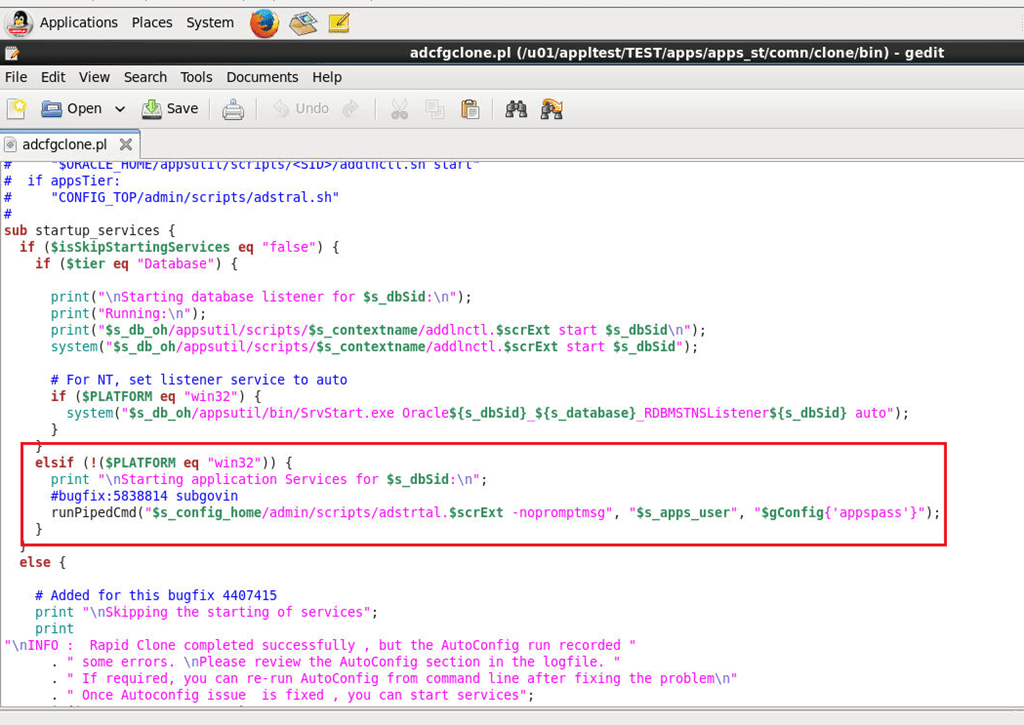
First step is to alter the $COMMON_TOP/clone/bin/adcfgclone.pl (perl script, please refer the image)

image

Change the portion in the highlighted block as shown below. This will stop the clone script from kick starting the application services after a successful clone.

[code language=”perl” gutter=”false”]
elsif (!($PLATFORM eq "win32")) {
print "\n Not Starting application Services for $s_dbSid:\n";
#bugfix:5838814 subgovin
#runPipedCmd("$s_config_home/admin/scripts/adstrtal.$scrExt -nopromptmsg", "$s_apps_user", "$gConfig{‘appspass’}");
}
[/code]
Now, you may proceed to disable all or selected alerts/concurrent programs using backend before starting the Application services.

Please note, this workaround is ONLY tested on 12.0.x releases of Oracle Applications. Please adjust to your environments.

References:

http://onlineappsdba.blogspot.com/2008/06/prevent-concurrent-requests-executing.html

http://oracle-latest-technology.blogspot.com/2013/11/how-to-disable-all-scheduled-concurrent.html

regards,

rajesh

Oracle EBS R12 | Inventory | Receipts stuck in pending status

Sometimes the receipts against internal requests could get into trouble with the status pending. While the requester tries to receive the transaction, receipts get created with zero quantities and the internal sales order yet in open status and the quantities are seen in staging location. Please follow the below to delete such pending lines to receive the quantities once again to the targeted sub-inventory

As inventory super user

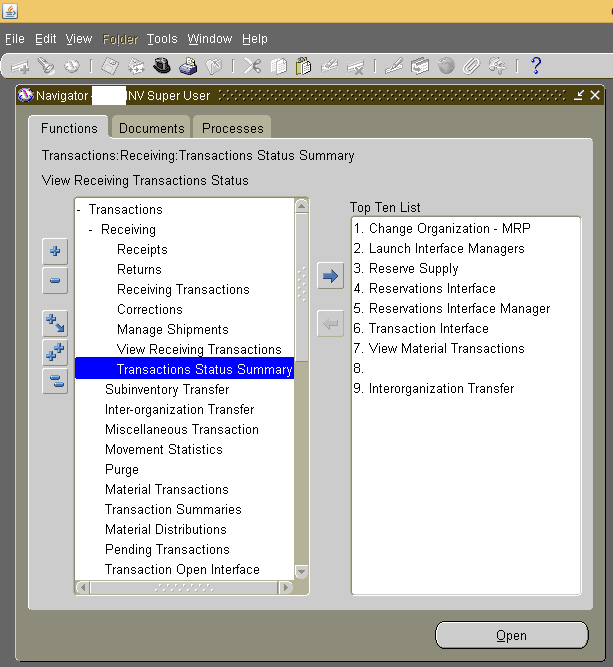
Transactions -> Receiving -> Transactions Status Summary

1

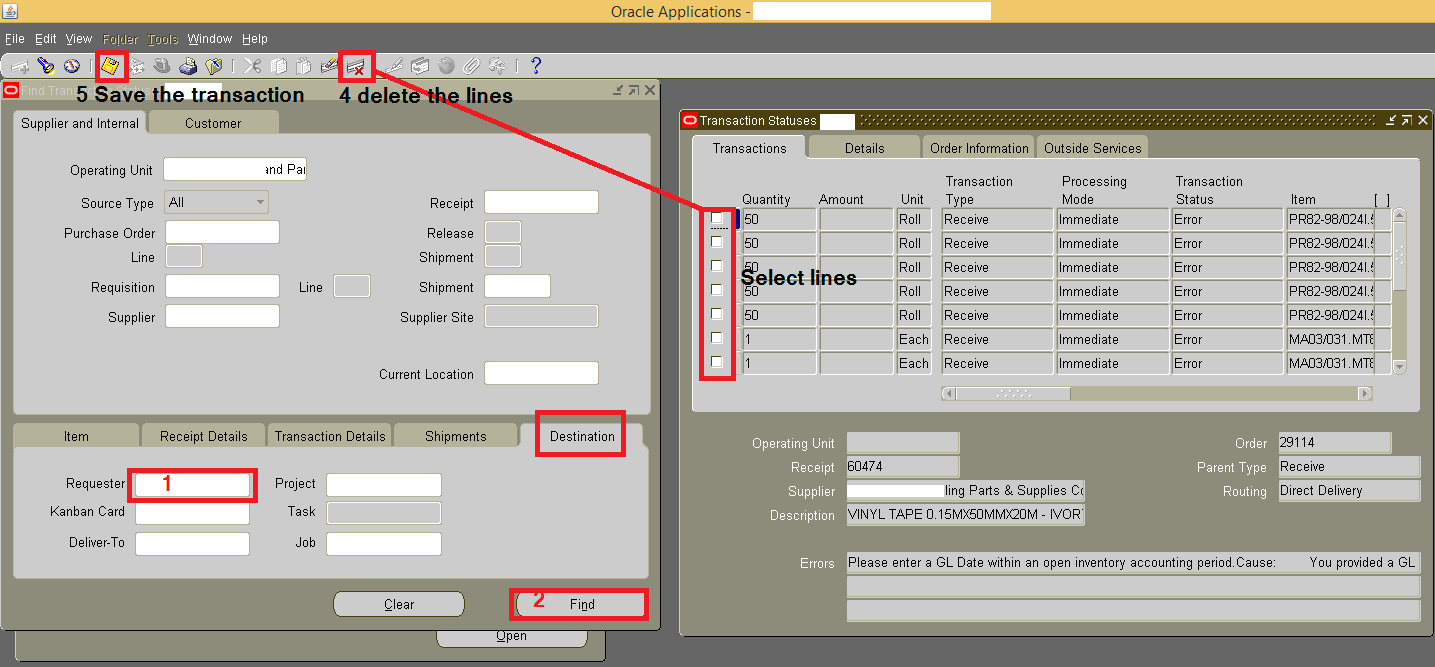
Under the tab “Supplier and Internal”

Select the “Destination” tab

Enter the name of the requester name (the name of the user who has created the internal material request to limit the lines fetched) & find the transactions

Delete the lines matching the transaction & save

2

Go back to receipts and enter the request number once again to receive the materials

regards,

for Windows7bugs

rajesh