Windows robocopy | Using volume ids instead of a drive letter.

You connect a removable disk to your Windows box, immediately the drive is assigned a letter. If you have multiple partitions on the disk, each partition will get a drive letter, and it’s how Windows work. This could cause some kind of annoyance when these disks are constantly disconnected for others and reconnected. One tricky solution to this is, assigning a drive letter like W,X,Y as Windows assigns the first free drive letter to the newly connected disk which is in the alphabetical order. Lack of functionality to reserve a drive letter for a particular device could add more troubles when batch files or PowerShell scripts totally depend upon drive letters for a successful execution, example a backup.

Today we will see how to use volume ids instead of drive letters for Windows robocopy, one of the best free backup tools that you could ever find.

Open command prompt as administrator and execute the command “mountvol”. Immediately after few help text, the output will show the ids for all the volumes currently present.
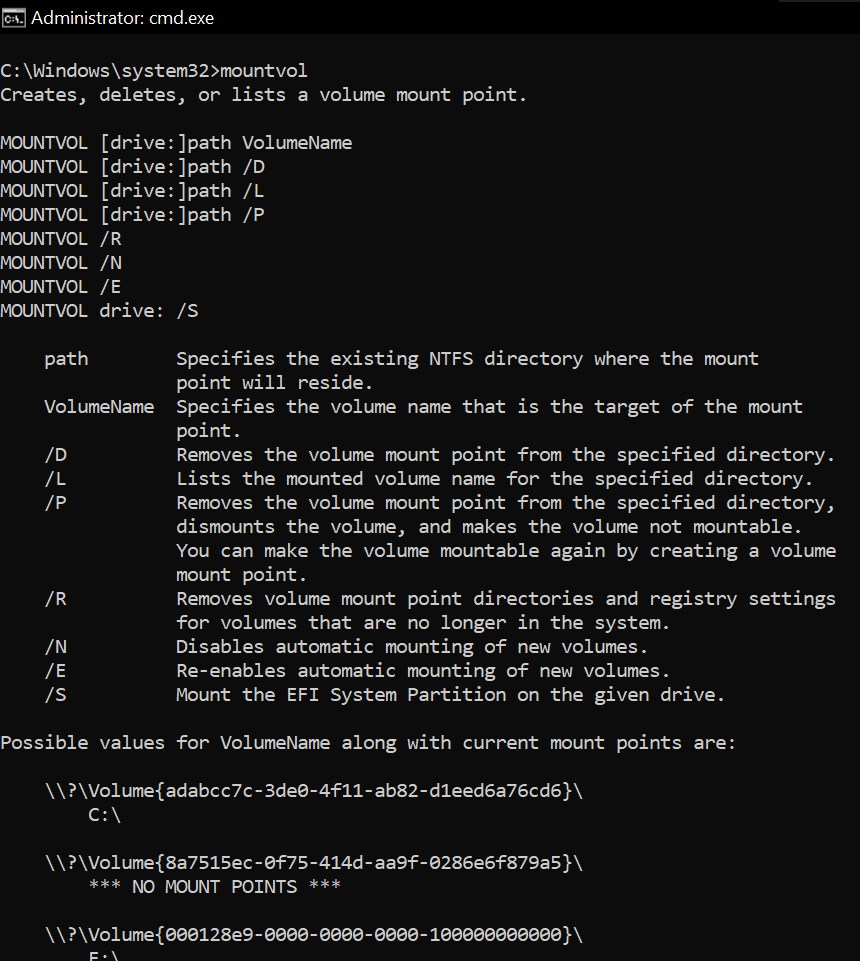
Copy the Volume Id for the drive letter which is your target/source. Modify the backup.ps1 as given below example!

#Author: Rajesh Thampi
#Date: Few years back
#Last modified on: 14th June 2025
#Partner-in-crime: Microsoft Copilot

<#
Hint
Use "mountvol" command at prompt to get the currently connected disks and their volume ids, drive letters
Get the volume id for the drive letter, replace below.
Volume Id will change when you format the disc next time.
The escape character is ` not ' after the variable $DriveLetter
#>

$VolumeID = "Volume{d2540346-9901-49e9-9f57-413d95f52744}"  # Replace with actual Volume ID
$DriveLetter = Get-Partition | Where-Object { $_.AccessPaths -match $VolumeID } | Select-Object -ExpandProperty DriveLetter

if ($DriveLetter) {
    Write-Output "Drive Letter: $DriveLetter`:\KeepACopy"
} else {
    Write-Output "No matching drive letter found for Volume ID: $VolumeID"
}


$DestinationPath="E:\ERP-Inhouse Developments"
$SourcePath="$DriveLetter`:\ERP-Inhouse Developments"
$logfile = "C:\Scripts\logs\Inhouse_Developments_$(Get-Date -Format 'yyyy-MM-dd_HH-mm-ss').log"

robocopy $SourcePath $DestinationPath /MIR /ZB /R:5 /W:10 /LOG:$logfile


$DestinationPath="E:\MyProjects"
$SourcePath="$DriveLetter`:\MyProjects"
$logfile = "C:\Scripts\logs\MyProjects_$(Get-Date -Format 'yyyy-MM-dd_HH-mm-ss').log"

robocopy $SourcePath $DestinationPath /MIR /ZB /R:5 /W:10 /LOG:$logfile


$DestinationPath="E:\KeepACopy"
$SourcePath="$DriveLetter`:\KeepACopy"
$logfile = "C:\Scripts\logs\KeepACopy_$(Get-Date -Format 'yyyy-MM-dd_HH-mm-ss').log"

robocopy $SourcePath $DestinationPath /MIR /ZB /R:5 /W:10 /LOG:$logfile

#Finally cleanup the log directory, deleting all files that are more than 5 days old.
#This is useful incase if you are regularly using the script with a scheduled job.
Get-ChildItem 'C:\Scripts\logs' -Filter '*.log' | Where-Object { $_.LastWriteTime -lt (Get-Date).AddDays(-5) } | Remove-Item

Adjust your scripts based on your requirements. Now, you don’t have to worry about the drive letter changes anymore. Just plug your removable disk, execute the PowerShell script as administrator and you are all good.

Just make sure that you have set the PowerShell Execution Policy properly before trying to run scripts.

That’s all folks.

Linux Backup | Using Labels for removable media

We use Tandberg RDX 2TB data cartridges for “EXTRA” backups on a daily basis. One of the major concerns while designing the homegrown solution was how to make the OS to mount the newly inserted cartridge to the same mount point every time, where the bash script would rsync the files. Please note, you can use the same with your other types of removable media also.

After some googling, consultations we decided to use Linux’s volume labeling for this requirement. I will do a walkthrough of all the processes involved. This should be useful for techies those do not use Linux on daily, however forced to at times.

Once after inserting a fresh cartridge, fdisk shows the above information against the cartridge. Identifying the device could take some practice for a Linux beginner, I am sorry about that. Making sure that you identified the correct device is the success key. Making blunders could land you up in unrecoverable mess. So be careful with rest of the instructions.

Remove the existing HPFS/NTFS/exFAT first

[root@hostname /]# fdisk /dev/sdc
Welcome to fdisk (util-linux 2.23.2).

Changes will remain in memory only, until you decide to write them.
Be careful before using the write command.


Command (m for help): m
Command action
   a   toggle a bootable flag
   b   edit bsd disklabel
   c   toggle the dos compatibility flag
   d   delete a partition
   g   create a new empty GPT partition table
   G   create an IRIX (SGI) partition table
   l   list known partition types
   m   print this menu
   n   add a new partition
   o   create a new empty DOS partition table
   p   print the partition table
   q   quit without saving changes
   s   create a new empty Sun disklabel
   t   change a partition's system id
   u   change display/entry units
   v   verify the partition table
   w   write table to disk and exit
   x   extra functionality (experts only)

List existing partitions, in our case RDX cartridge has single partition from the factory.

Command (m for help): p

Disk /dev/sdc: 2000.4 GB, 2000394739712 bytes, 3907020976 sectors
Units = sectors of 1 * 512 = 512 bytes
Sector size (logical/physical): 512 bytes / 512 bytes
I/O size (minimum/optimal): 512 bytes / 512 bytes
Disk label type: dos
Disk identifier: 0x00000000

   Device Boot      Start         End      Blocks   Id  System
/dev/sdc1            2048  3907020799  1953509376    7  HPFS/NTFS/exFAT

We will proceed with deleting the existing partition using the command “d”

Command (m for help): d
Selected partition 1
Partition 1 is deleted

Command (m for help): w
The partition table has been altered!

Calling ioctl() to re-read partition table.
Syncing disks.

We will create a new partition

Command (m for help): p

Disk /dev/sdc: 2000.4 GB, 2000394739712 bytes, 3907020976 sectors
Units = sectors of 1 * 512 = 512 bytes
Sector size (logical/physical): 512 bytes / 512 bytes
I/O size (minimum/optimal): 512 bytes / 512 bytes
Disk label type: dos
Disk identifier: 0x00000000

   Device Boot      Start         End      Blocks   Id  System

Command (m for help): n
Partition type:
   p   primary (0 primary, 0 extended, 4 free)
   e   extended
Select (default p): p
Partition number (1-4, default 1):
First sector (2048-3907020975, default 2048):
Using default value 2048
Last sector, +sectors or +size{K,M,G} (2048-3907020975, default 3907020975):
Using default value 3907020975
Partition 1 of type Linux and of size 1.8 TiB is set

Command (m for help): w
The partition table has been altered!

Calling ioctl() to re-read partition table.
Syncing disks.

Confirm the changes

Command (m for help): p

Disk /dev/sdc: 2000.4 GB, 2000394739712 bytes, 3907020976 sectors
Units = sectors of 1 * 512 = 512 bytes
Sector size (logical/physical): 512 bytes / 512 bytes
I/O size (minimum/optimal): 512 bytes / 512 bytes
Disk label type: dos
Disk identifier: 0x00000000

   Device Boot      Start         End      Blocks   Id  System
/dev/sdc1            2048  3907020975  1953509464   83  Linux

Command (m for help): q

Now we will proceed to format the file system for ext4. There are newer file systems, however our requirement is to have ext4 for standardization across the attached devices.

[root@hostname /]# mkfs.ext4 /dev/sdc1
mke2fs 1.45.4 (23-Sep-2019)
/dev/sdc1 contains a ntfs file system labelled 'QuikStor 2.0TB'
Proceed anyway? (y,N) y
Creating filesystem with 488377366 4k blocks and 122101760 inodes
Filesystem UUID: 056c2a9d-2482-4637-a823-9ef1e2ae9d30
Superblock backups stored on blocks:
        32768, 98304, 163840, 229376, 294912, 819200, 884736, 1605632, 2654208,
        4096000, 7962624, 11239424, 20480000, 23887872, 71663616, 78675968,
        102400000, 214990848

Allocating group tables: done
Writing inode tables: done
Creating journal (262144 blocks):
done
Writing superblocks and filesystem accounting information: done

Finally, the most import part of the entire exercise. Labeling the partition. You may need additional software downloads for e2label.

[root@hostname /]# e2label /dev/sdc1 RDXTAPE

Finally modifying the fstab to mount the device automatically

#
# /etc/fstab
# Created by anaconda on Wed Sep 16 11:06:12 2020
#
# Accessible filesystems, by reference, are maintained under '/dev/disk'
# See man pages fstab(5), findfs(8), mount(8) and/or blkid(8) for more info
#
LABEL=RDXTAPE     /RDX    ext4   defaults 0 0

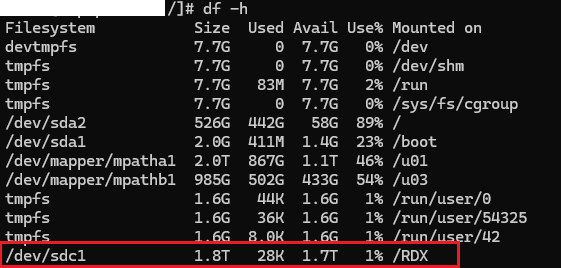
Issue the command mount to immediately mount this partition to a mount point.

[root@hostname /]# mount -a

That’s all folks!